
PETG VS PLA
When it comes to 3D printing, the choice of material can significantly impact the final product. Two popular materials in the world of 3D printing are PLA (Polylactic Acid) and PETG (Polyethylene Terephthalate Glycol-modified). Each has its own properties, advantages, and disadvantages. PLA is stiffer and more brittle than PETG. PETG is more durable and heat-resistant than PLA.
This article aims to provide a comprehensive comparison between PLA and PETG and help you make an informed decision for your next 3D printing project.

PLA: The Versatile Workhorse
PLA is the most widely used 3D printer filament. It is made from organic material. PLA is a lactic acid polymer and is easily biodegradable. It is very popular among 3D printers because it is easy to print and costs little.
Properties:
- PLA is a biodegradable thermoplastic made from renewable resources like corn starch or sugarcane.
- It is known for its ease of use and minimal warping during printing.
- PLA has a relatively low printing temperature, usually between 180-220 °C, making it compatible with a wide range of 3D printers.
- It is available in a wide variety of colors and is well-suited for detailed and intricate prints.
- PLA has a glossy finish and is often used for artistic and decorative prints.
Advantages:
- Easy to print: PLA is beginner-friendly and ideal for those new to 3D printing, as it rarely causes printing issues.
- Biodegradable: PLA is an eco-friendly option as it breaks down naturally over time.
- Print precision: PLA is better suited for maintaining part precision due to its better printability and lower warping. However, under constant load, PLA tends to creep. For smaller components, PETG adheres better because it is more viscous in its molten state.
Disadvantages:
- Limited heat resistance: PLA has lower heat tolerance than some other materials, making it unsuitable for high-temperature applications.
- Brittleness: Although PLA is relatively strong, it can be brittle, making it less suitable for high-stress parts.
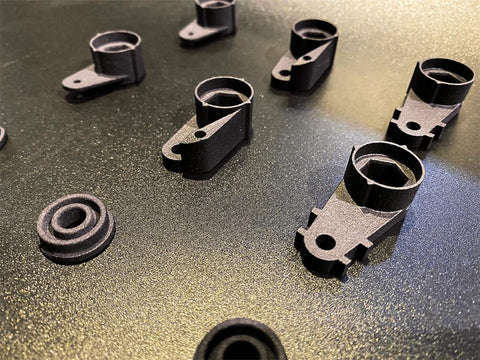
PETG: The Durable Contender
PETG, or Polyethylene Terephthalate Glycol, is a thermoplastic polymer resin commonly used for 3D printing filaments. PETG consists of long polymer chains made up of repeating ethylene terephthalate units. The G stands for glycol. Its structure includes aromatic benzene rings linked by ester groups to aliphatic ethylene glycol units. This arrangement of stiff aromatic rings and flexible ethylene glycol chains gives PETG its unique properties and processing capabilities.
Properties:
- PETG is a tough, durable, and recyclable thermoplastic.
- PETG is stronger and more resilient than PLA. Therefore, it is suitable for 3D printing functional parts such as drones.
- It offers excellent layer adhesion, reducing the risk of delamination during printing.
- PETG has a higher printing temperature range, usually 220-250 °C, making it suitable for functional parts.
- It has good chemical resistance and is more prone to moisture absorption than PLA.
- PETG prints often have a semi-gloss or matte finish.
Advantages:
- Durability: PETG is stronger and more impact-resistant than PLA, making it suitable for mechanical parts and functional prototypes.
- Heat resistance: It can withstand higher temperatures, making it suitable for objects exposed to heat or used outdoors.
- Chemical resistance: PETG is less prone to chemical decomposition than PLA.
- Transparency: Highly transparent objects, such as fruit juice bottles, can be made from PETG.
Disadvantages:
- Build plate adhesion: PETG can tend to stick too strongly to the build plate, requiring extra caution when removing prints.
- Printing challenges: PETG may be less forgiving than PLA when it comes to issues like stringing or overhangs.
- Slight stringing: PETG often causes stringing because it requires high temperatures to flow well. To avoid stringing with PETG during the printing process, you need to adjust your 3D print parameter settings and may even need to perform many print tests.
- Cost: PETG typically costs between $20 and $25 per kg, making it more expensive than PLA due to higher production costs and better properties. While PLA is cheaper, it is not always the most cost-effective option, as it is not as durable as PETG and may need to be replaced more frequently.
Choosing between PLA and PETG
The choice between PLA and PETG ultimately depends on your specific 3D printing requirements:
- Choose PLA if: You are a beginner looking for an easy-to-print, eco-friendly material for artistic or decorative prints. PLA is also a great choice for educational purposes and models not exposed to extreme conditions.
-
Choose PETG if: You need durable, functional parts that can withstand higher temperatures and mechanical stress. PETG is a versatile material suitable for a wide range of applications, such as mechanical components, enclosures, and outdoor use.
Conclusion
In the debate between PLA and PETG, there is no one-size-fits-all answer. Each material has its strengths and weaknesses. Therefore, you should carefully weigh your project requirements to make the right choice and fully utilize your 3D printer's potential.
Whether it's the simplicity of PLA or the durability of PETG, both materials have their place in the world of 3D printing.
FREQUENTLY ASKED QUESTIONS
1. Is PETG better than PLA for 3D printing?
No! For most 3D printing jobs, PLA is the better choice. PLA is cheaper and easier to process in 3D printing than PETG. PETG is stronger than PLA and can achieve a smoother surface.
2. What is the biggest disadvantage of PETG compared to other filaments?
PETG is prone to stringing during 3D printing, making it difficult to print.
——————————————————


